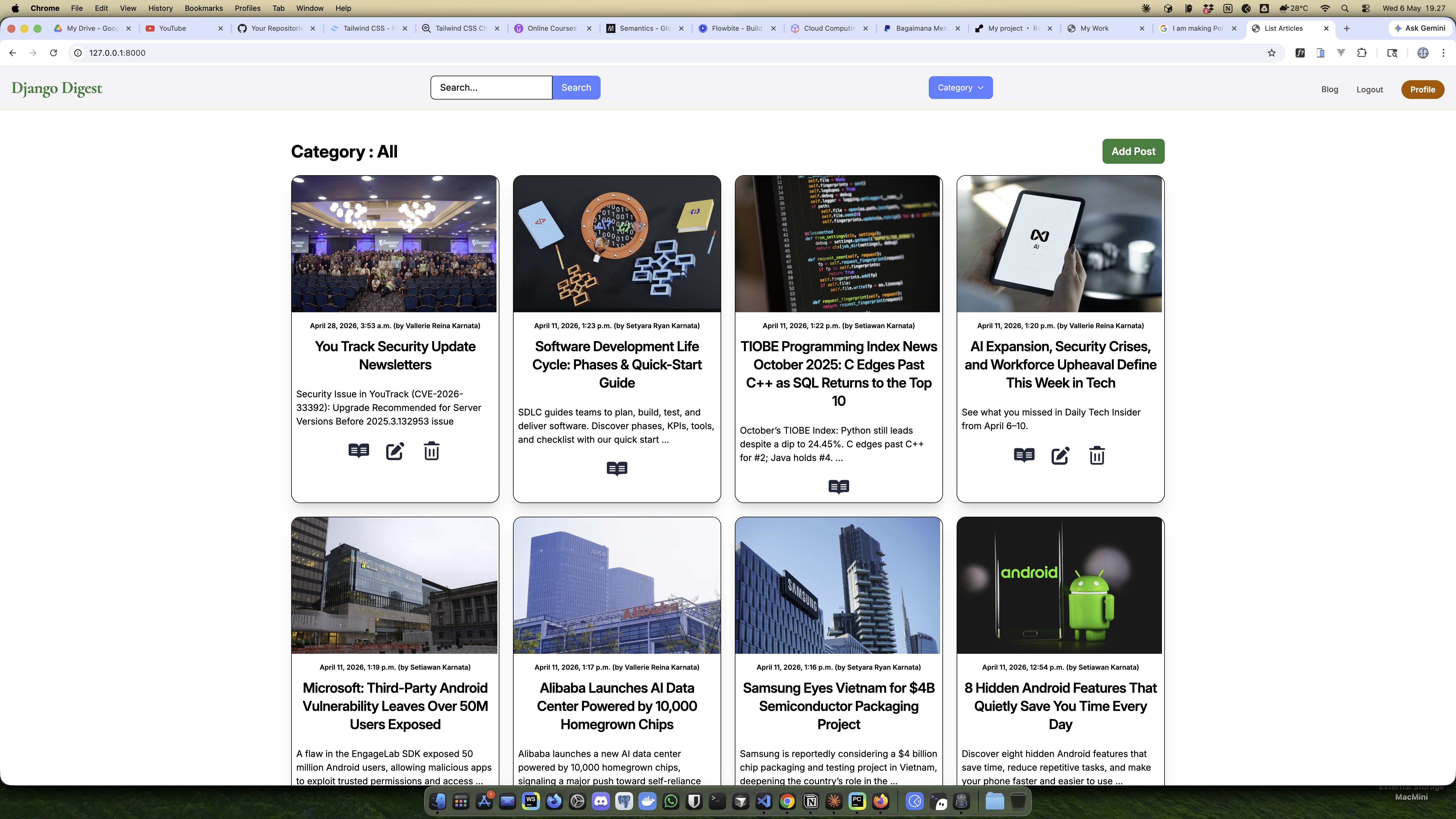
Blog App with Elastic Search
"Django Digest"
-
Advanced Search Architecture (Elasticsearch & Docker)
To provide lightning-fast, relevant results, I integrated Elasticsearch as the primary search engine. By containerizing the service with Docker, I ensured the search infrastructure is decoupled, scalable, and mirrors production environments exactly. This setup allows for complex full-text searches and fuzzy matching that standard database queries cannot handle.
-
Premium Content Authoring (CKEditor 5)
Content creation is powered by CKEditor 5, providing a modern, "What You See Is What You Get" (WYSIWYG) interface. This allows authors to format rich text, embed media, and manage layouts effortlessly, ensuring that the editorial workflow is as intuitive as a professional CMS.
-
Cloud-Native Asset Management (AWS S3)
Designed for high availability, the application offloads all static and media files to an AWS S3 Bucket. This move ensures that the application remains "stateless," allowing for faster load times via global CDNs and ensuring that user-uploaded content is stored securely and independently of the application server.
-
Secure Configuration (Django-Environ)
Security and the "Twelve-Factor App" methodology are central to this project. Using Django-Environ, I managed sensitive credentials and API keys through environment variables. This ensures that the codebase remains clean of hardcoded secrets and is easily portable across development, staging, and production environments.
-
Modern, Responsive UI (Tailwind CSS)
The frontend is built with Tailwind CSS, utilizing a utility-first approach to create a bespoke, highly responsive design. This ensures the blog is mobile-optimized and maintains a lightweight CSS footprint, significantly improving core web vitals and user retention.
-
Optimized Data Flow (Context Processors)
To enhance the user navigation experience, I implemented custom Context Processors. This allows global data—such as blog categories—to be injected into every template without redundant view logic. It ensures a consistent UI and simplifies the codebase by keeping data fetching "DRY" (Don't Repeat Yourself).
-
Robust Identity Management (Django Auth)
I leveraged Django’s built-in Authentication system to provide a secure foundation for user management. The platform includes full-cycle account handling, including secure user registration, password changes, and email-based password resets, ensuring user data is handled according to industry security standards.